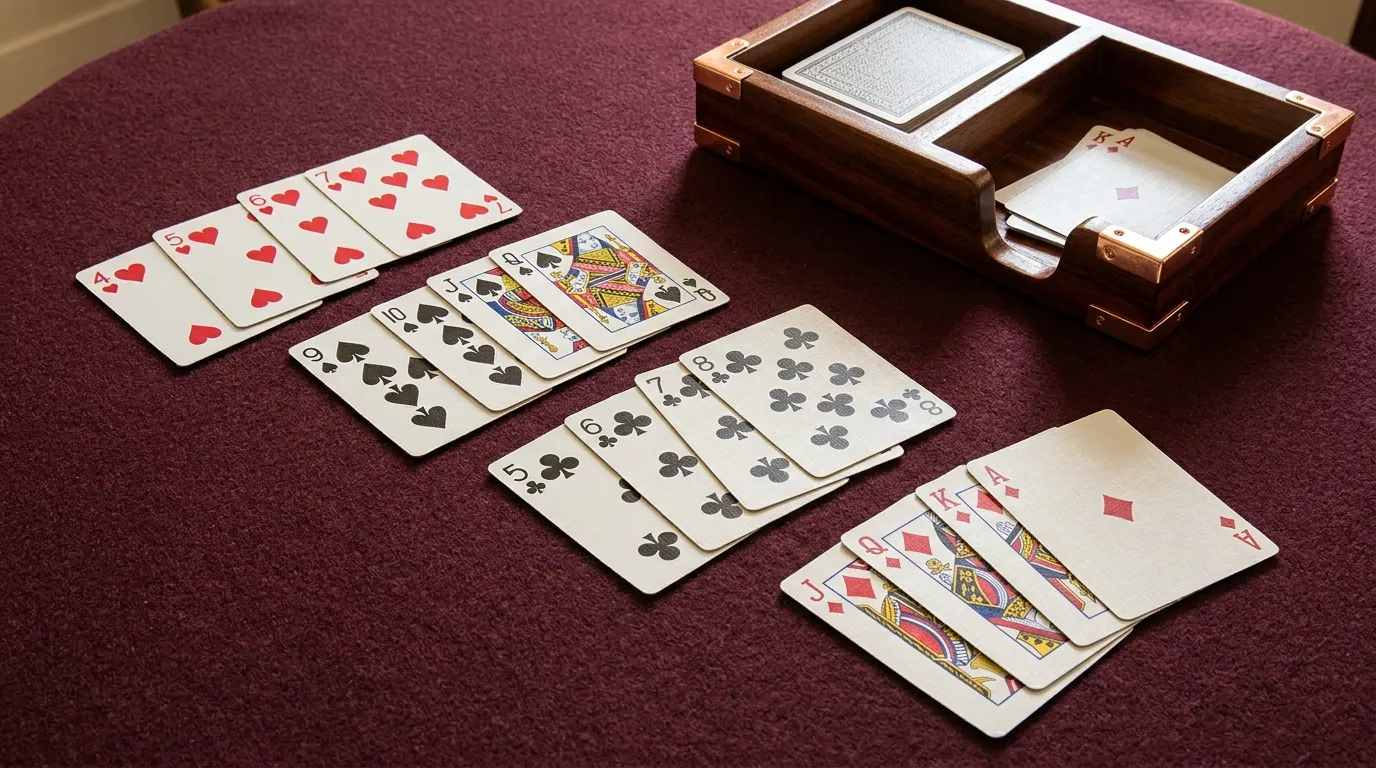
Pool Rummy: Game Overview, Rules, and Beginner Guide
Pool Rummy is a popular variation of Indian Rummy that combines traditional thirteen-card gameplay with a cumulative scoring and elimination system. Instead of treating every deal as a completely separate competition, Pool Rummy tracks penalty points across multiple deals until participants reach a specified elimination threshold.
The game is commonly associated with two formats: 101 Pool Rummy and 201 Pool Rummy. Both generally follow the familiar Indian Rummy rules for creating sequences and sets, but they differ in their elimination limits, common drop penalties, and overall match duration. Understanding these differences helps beginners interpret how the game progresses.
Like other thirteen-card Rummy formats, Pool Rummy requires players to arrange their cards into valid combinations. A successful declaration generally includes at least two sequences, one of which must be a pure sequence. Players draw and discard cards during their turns while attempting to complete a valid hand.
One of Pool Rummy's defining features is that penalty points accumulate between deals. A player who does not complete a valid declaration receives a score determined by the applicable rules. Once that cumulative score reaches the game's elimination threshold, the participant is normally removed from the match unless a permitted re-entry rule applies.
Digital versions of Pool Rummy may include automatic card sorting, group validation, turn timers, scoreboards, and elimination notifications. These functions can make gameplay information easier to follow, but the underlying rules remain important because platforms may differ in their scoring, joker handling, and match procedures.
Pool Rummy also requires appropriate legal and responsible gaming awareness. In India, the Promotion and Regulation of Online Gaming Act, 2025 and the implementing Online Gaming Rules, 2026 prohibit online money games as defined by the legislation while establishing a framework for permitted online social games and esports. The 2026 Rules came into force on May 1, 2026.
This beginner guide explains Pool Rummy rules, pure and impure sequences, sets, jokers, 101 and 201 Pool formats, scoring calculations, drop penalties, elimination procedures, and responsible gaming practices. It focuses on understanding the game without suggesting guaranteed winnings or financial returns.
What Is Pool Rummy?
Pool Rummy is a variation of Indian Rummy in which participants play multiple thirteen-card deals while accumulating penalty points.
The main objective is to complete valid Rummy hands and remain below the match's elimination threshold. The game generally continues until only one eligible participant remains.
Unlike Points Rummy, which commonly settles each deal separately, Pool Rummy connects the results of successive deals through cumulative scoring.
Main Features of Pool Rummy
- Thirteen-Card Hands: Each player generally receives thirteen cards at the beginning of a deal.
- Multiple Deals: A Pool Rummy match continues across several deals.
- Cumulative Scoring: Penalty points are carried forward between deals.
- Pure Sequence: At least one valid pure sequence is mandatory for a standard declaration.
- Second Sequence: Another valid sequence is required.
- Sets: Remaining cards may be arranged into valid same-rank groups.
- Jokers: Printed and wild jokers may substitute for cards under permitted conditions.
- 101 Pool: A common format with an elimination threshold of 101 penalty points.
- 201 Pool: A common format with an elimination threshold of 201 penalty points.
- Drop Penalties: Players may receive specified points for leaving a deal early.
- Elimination: Participants reaching the applicable limit are removed from the match under standard rules.
- Re-Entry Variations: Certain game versions may provide additional participation rules.
The exact scoring, elimination, and re-entry procedures depend on the selected Pool Rummy variant.
For more background, explore Pool Rummy rules, elimination formats, and gameplay explained.
1. Understanding the Main Objective of Pool Rummy
Pool Rummy combines the traditional objective of completing valid Rummy combinations with the additional challenge of cumulative scoring.
Create a Valid Hand
Players attempt to organize thirteen cards into permitted sequences and sets.
Include a Pure Sequence
At least one sequence must be pure.
Form a Second Sequence
A standard declaration requires another valid sequence, which may be pure or impure.
Arrange Remaining Cards
All other cards must belong to acceptable sequences or sets.
Complete Individual Deals
A deal ends when a valid declaration or another applicable ending condition occurs.
Understand Penalty Points
Players who do not complete a valid declaration receive penalties according to the scoring rules.
Track Cumulative Scores
These penalties accumulate across deals rather than being reset after every result.
Recognize the Elimination Threshold
A participant reaching the relevant 101-point or 201-point threshold is normally eliminated.
Understand the Final Match Result
Under standard elimination rules, the match ends when only one eligible player remains.
2. Cards and Decks Used in Pool Rummy
Pool Rummy generally uses the same card structure as other thirteen-card Indian Rummy formats.
Standard Playing Cards
A conventional deck contains 52 cards.
Four Suits
The suits are hearts, diamonds, clubs, and spades.
Thirteen Ranks
Each suit contains ace, two through ten, jack, queen, and king.
Multiple Decks
Many multiplayer formats use two standard decks.
Printed Jokers
Special printed joker cards may be included in the card supply.
Wild Jokers
A card rank may be designated as wild for the current deal.
Duplicate Cards
When multiple decks are used, identical cards may exist within the overall game.
Thirteen Cards Per Player
Each participant begins a deal with thirteen cards.
Deck Variations
The precise number of decks and jokers may differ according to the platform and number of participants.
3. Understanding Pure Sequences
A pure sequence is one of the most important combinations in Pool Rummy because it is mandatory for a valid declaration.
Definition of a Pure Sequence
A pure sequence contains at least three consecutive cards of the same suit without a joker substituting for a missing card.
Three-Card Example
4♥, 5♥, and 6♥ form a valid pure sequence.
Four-Card Example
7♣, 8♣, 9♣, and 10♣ form a valid four-card pure sequence.
Consecutive Ranks
The cards must follow a valid numerical or face-card order.
Matching Suits
Every natural card must belong to the same suit.
Joker Substitution Restriction
A joker cannot replace a missing card while preserving pure-sequence status.
Natural Wild Card
Some standard Indian Rummy rules permit a card designated as wild to appear naturally in a pure sequence when used as its printed rank and suit.
Importance for Declaration
A hand without the required pure sequence generally cannot qualify as a valid declaration.
Importance for Scoring
Whether the player has formed the mandatory sequences may affect how penalties are calculated after a deal.
For additional examples, review Rummy sequence, set, and declaration rules.
4. Understanding Impure Sequences
An impure sequence contains a valid consecutive arrangement of cards while using one or more jokers as substitutes.
Minimum Sequence Length
An impure sequence generally contains at least three cards.
Matching Natural Suits
The natural cards normally belong to the same suit.
Joker Substitution
A joker represents a missing card required to complete the sequence.
Example
5♠, printed joker, and 7♠ may form an impure sequence representing 5♠, 6♠, and 7♠.
Multiple Jokers
Some rule sets permit more than one joker within a valid impure sequence.
Second Sequence Requirement
An impure sequence can satisfy the second-sequence requirement when a pure sequence is also present.
Pure Sequence Difference
Joker substitution distinguishes an impure sequence from a pure sequence.
Declaration Limitations
Two impure sequences do not replace the mandatory pure sequence.
Platform Rules
Players should review whether their selected game applies any special restrictions on joker arrangements.
5. How Sets Work in Pool Rummy
Sets are valid combinations consisting of cards of the same rank.
They help organize remaining cards after the mandatory sequence requirements have been satisfied.
Three-Card Set
A standard three-card set contains three equal-ranked cards in different suits.
Example
8♥, 8♦, and 8♣ form a valid set.
Four-Card Set
A set may contain four cards of the same rank, one from each suit.
Different Suit Requirement
Natural cards in the same set normally use distinct suits.
Duplicate Natural Cards
Two identical natural cards from separate decks generally cannot form the same valid set together.
Joker Substitution
Printed or wild jokers may substitute for missing cards according to the rules.
Example With a Joker
King of hearts, king of spades, and a printed joker may form a valid set.
Sets Versus Sequences
Sets use equal ranks, while sequences use consecutive ranks.
Mandatory Sequence Rules
Even several valid sets cannot replace the required two sequences.
6. Printed Jokers and Wild Jokers
Jokers can make certain card combinations possible by representing other cards.
Pool Rummy commonly includes both printed and wild joker mechanisms.
Printed Joker
A printed joker is a special card included in the game setup.
Wild Joker
A wild joker is generally a normal card rank designated as wild for the current deal.
Example of Wild Selection
If the rank eight is selected as wild, cards of that rank may function as jokers under the applicable rules.
Impure Sequences
Jokers can substitute for missing positions in permitted impure sequences.
Sets
Jokers may also substitute for missing cards in valid sets.
Pure Sequence Restriction
A joker used as a substitute cannot create a pure sequence.
Natural Wild Card Use
Some formats permit a wild-ranked card to retain its natural role in a pure sequence.
Joker Point Value
Jokers generally carry zero penalty points.
Special Rules
Some games use different procedures when a printed joker appears during wild-joker selection.
Correct Interpretation
The selected platform's rules determine which joker combinations are valid.
7. How Drawing and Discarding Works
Drawing and discarding are the main actions repeated during a standard Pool Rummy deal.
Starting Hand
Each player begins with thirteen cards.
Closed Deck
The closed deck contains face-down cards that are not visible before being drawn.
Open Deck
The open deck or discard pile contains cards discarded during gameplay.
Drawing a Card
On a standard turn, the player obtains one card from an eligible draw source.
Temporary Hand Size
After drawing, the player normally holds fourteen cards.
Discarding
The player discards one card to return to a thirteen-card hand.
Turn Completion
A turn ends when the required discard or permitted declaration action is completed.
Open-Pile Restrictions
Some games restrict which cards may be retrieved from the open pile.
Repeating the Process
Turns continue until a valid declaration or another ending condition occurs.
Connection and Timer Conditions
Digital games may impose time limits or penalties when players fail to complete their turns.
8. The Complete Pool Rummy Gameplay Process
A Pool Rummy match contains individual deals that contribute to the overall cumulative score.
Step 1: Select the Pool Format
The game establishes whether the match uses a 101-point, 201-point, or other supported elimination limit.
Step 2: Prepare the Decks
The required cards and jokers are prepared according to the table rules.
Step 3: Deal Thirteen Cards
Every eligible player receives thirteen cards.
Step 4: Identify the Wild Joker
Where applicable, the wild-joker rank is displayed.
Step 5: Establish Draw Piles
The closed deck and open discard pile are prepared.
Step 6: Begin the Turns
Players draw and discard in the prescribed order.
Step 7: Organize Combinations
Players attempt to create valid sequences and sets.
Step 8: Declare a Completed Hand
A player with a valid arrangement follows the declaration procedure.
Step 9: Validate the Declaration
The hand is checked against the required combination rules.
Step 10: Calculate Deal Penalties
The remaining participants receive applicable penalty points.
Step 11: Update Cumulative Scores
Each participant's new penalty points are added to their previous total.
Step 12: Apply Elimination Rules
Players reaching the specified limit are normally eliminated.
Step 13: Start the Next Deal
Eligible participants continue into the following deal.
Step 14: Complete the Match
The match ends when the applicable conditions are satisfied, usually when one eligible player remains.
9. Understanding the 101 Pool Rummy Format
101 Pool Rummy is a common version of Pool Rummy that uses a cumulative elimination threshold of 101 penalty points.
Elimination Threshold
A player is normally eliminated upon reaching or exceeding 101 cumulative penalty points.
Multiple Deals
The match continues across successive deals.
Cumulative Scoring
Penalties from completed deals are added to the player's existing total.
Example
A player with 72 cumulative points who receives another 35 penalty points reaches 107 and is eliminated under standard 101 Pool rules.
Common First-Drop Penalty
Some versions assign 20 points for a first drop.
Common Middle-Drop Penalty
Some versions assign 40 points for a middle drop.
Ordinary Losing-Hand Cap
Many formats cap an ordinary losing-hand penalty at 80 points.
Match Progression
Participants continue until only one eligible player remains, subject to special match rules.
Provider Differences
Specific drop and re-entry conditions may vary between versions.
10. Understanding the 201 Pool Rummy Format
201 Pool Rummy uses the same general card-combination principles but permits a larger cumulative penalty total before elimination.
Elimination Threshold
A player is normally eliminated upon reaching or exceeding 201 cumulative penalty points.
Multiple Deals
The match continues through repeated deals until the completion conditions are satisfied.
Cumulative Penalties
Scores accumulate after each completed deal.
Example
A player with 180 penalty points who receives another 25 reaches 205 and is eliminated under standard 201 Pool rules.
Common First-Drop Penalty
Some 201 Pool formats assign 25 points for a first drop.
Common Middle-Drop Penalty
Some 201 Pool formats assign 50 points for a middle drop.
Maximum Ordinary Penalty
Many versions use an 80-point cap for a standard losing hand.
Match Duration
The higher elimination threshold may allow matches to continue across more deals.
Re-Entry Variations
Some 201 Pool formats offer additional re-entry options under defined rules.
Table-Specific Conditions
The official rules determine the precise scoring and elimination procedures.
11. Comparing 101 Pool and 201 Pool Rummy
The main difference between these formats is the cumulative score required for elimination.
101 Pool Threshold
101 Pool normally eliminates players reaching 101 cumulative penalty points.
201 Pool Threshold
201 Pool normally eliminates players reaching 201 cumulative penalty points.
Pure Sequence Requirement
Both commonly require at least one pure sequence for a valid declaration.
Second Sequence Requirement
Both commonly require another valid sequence.
Card Values
The underlying penalty values are generally similar.
First-Drop Differences
Common examples use 20 points in 101 Pool and 25 points in 201 Pool.
Middle-Drop Differences
Common examples use 40 points in 101 Pool and 50 points in 201 Pool.
Match Length
201 Pool generally has the potential for longer matches because players can accumulate more penalties before elimination.
Re-Entry
Availability depends on the selected platform and match rules.
Important Comparison
The higher elimination threshold changes the match structure but does not remove uncertainty from card distribution.
12. Card Values and Penalty Scoring
Penalty points determine how quickly a player approaches the elimination threshold.
Number Cards
Cards from two through ten generally carry their face values.
Face Cards
Jacks, queens, and kings commonly count as ten points each.
Aces
Aces commonly count as ten points.
Jokers
Printed and wild jokers generally contribute zero penalty points.
Winner's Penalty
A player making a valid winning declaration generally receives zero penalty points for the deal.
Unmatched Cards
When mandatory sequences are present, unmatched cards are typically counted toward the losing player's penalty.
Example
If the relevant unmatched cards are 5, 8, and king, their total is 23 points under standard card values.
Missing Mandatory Sequences
Some scoring rules count all nonjoker cards when the player lacks the required sequences.
Penalty Cap
Many formats limit an ordinary losing-hand score to 80 points.
Specific Rules
Actual penalty calculations depend on the selected game and whether valid mandatory combinations are present.
For additional background, review Points Rummy rules and scoring explained.
13. How Cumulative Scoring and Elimination Work
Cumulative scoring distinguishes Pool Rummy from formats that settle every deal independently.
Starting Score
Players generally begin a new match with zero cumulative penalty points.
Deal Penalty
After each deal, applicable penalty points are assigned.
Running Total
The new points are added to the player's previous cumulative score.
Illustrative Calculation
Suppose a player receives penalties of 28, 17, and 35 points over three deals.
The cumulative total is 80 points.
Threshold Comparison
The game compares the running total against the selected elimination limit.
Reaching the Limit
Under standard rules, reaching or exceeding the threshold results in elimination.
Remaining Players
Noneliminated players continue into subsequent deals.
Final Participant
The match ordinarily finishes when only one eligible participant remains.
Re-Entry Exceptions
Some variants permit a previously eliminated or eligible player to re-enter under special conditions.
Understanding Scoreboards
Digital interfaces may display cumulative penalties and elimination status automatically.
14. First Drop, Middle Drop, and Wrong Declaration Rules
Pool Rummy formats may allow players to leave an individual deal before it is completed.
These actions generally carry predefined penalties.
First Drop
A first drop generally occurs before a player takes their first active turn.
101 Pool First Drop
A common 101 Pool rule assigns 20 penalty points.
201 Pool First Drop
A common 201 Pool rule assigns 25 penalty points.
Middle Drop
A middle drop usually occurs after the player has already participated in the deal.
101 Pool Middle Drop
Some 101 Pool formats assign 40 penalty points.
201 Pool Middle Drop
Some 201 Pool formats assign 50 penalty points.
Wrong Declaration
A declaration that fails the required combination rules may be penalized.
Common Wrong-Declaration Penalty
Many standard formats assign 80 points for an invalid declaration.
Missed Turns
Some digital games impose an automatic drop after repeated missed turns.
Connection Problems
Technical interruptions may affect gameplay and trigger penalties if the platform applies inactivity rules.
Different Provider Rules
All penalty values should be verified through the specific table's current instructions.
15. Valid Declarations and Common Invalid Hands
A correct declaration must satisfy every required sequence and grouping condition.
Mandatory Pure Sequence
At least one valid pure sequence is required.
Second Sequence
Another sequence must be present.
Complete Grouping
All thirteen cards must form valid combinations.
Illustrative Valid Hand
- 4♥, 5♥, 6♥ — pure sequence.
- 9♣, 10♣, J♣ — second pure sequence.
- 7♠, 7♥, 7♦ — valid set.
- 2♠, 3♠, 4♠, 5♠ — four-card pure sequence.
This arrangement uses thirteen cards and satisfies the standard declaration requirements.
Missing Pure Sequence
A hand containing only impure sequences and sets is generally invalid.
Only One Sequence
A pure sequence and several sets are insufficient if the second sequence is missing.
Mixed-Suit Sequence
4♥, 5♣, and 6♥ do not form a valid sequence.
Duplicate Natural Cards
Two identical cards from separate decks generally cannot form the same set together.
Invalid Ace Order
King-ace-two is not a standard valid sequence.
Penalty Consequences
Submitting an invalid declaration may result in a significant penalty and potentially elimination if the cumulative threshold is reached.
16. Pool Rummy Versus Points Rummy and Deals Rummy
Pool, Points, and Deals Rummy share many fundamental thirteen-card rules but differ in how match results are determined.
Pool Rummy
Penalty points accumulate across multiple deals until players reach an elimination threshold.
Points Rummy
Individual deals are generally settled separately.
Deals Rummy
A match consists of a predetermined number of deals.
Sequence Requirements
All three commonly require at least two sequences, including one pure sequence.
Drawing and Discarding
The basic draw-and-discard mechanics remain broadly similar.
Scoring Structure
Pool Rummy uses cumulative elimination, Points Rummy uses separate deal scoring, and Deals Rummy uses results across a fixed match.
Match Duration
Pool and Deals Rummy generally involve multiple deals, while Points Rummy can end after a single deal.
Different Match Objectives
The required card combinations are familiar, but the conditions for overall match completion differ.
Platform Variations
Providers may apply different timers, penalties, and special rules.
For additional comparisons, review Deals Rummy rules and match formats.
17. Common Beginner Mistakes in Pool Rummy
Pool Rummy beginners may understand individual card combinations but overlook cumulative scoring and elimination rules.
Ignoring the Pure Sequence
A standard declaration requires at least one pure sequence.
Forming Only One Sequence
A second valid sequence is mandatory.
Confusing Sets With Sequences
Sets contain equal-ranked cards, while sequences require consecutive ranks of the same suit.
Incorrect Joker Use
A joker used as a substitute cannot make a pure sequence.
Misunderstanding Ace Rules
King-ace-two is not a standard valid sequence.
Ignoring Cumulative Scores
Penalty points remain relevant across multiple deals.
Confusing 101 and 201 Pool
The elimination thresholds and common drop penalties differ.
Misreading Drop Penalties
Leaving a deal may still produce a significant penalty.
Submitting Invalid Declarations
Incorrect declarations may trigger penalties that affect elimination.
Assuming Re-Entry Is Always Available
Some versions prohibit re-entry or apply strict conditions.
Ignoring Turn Timers
Digital games may impose automatic penalties after inactivity.
Relying on Guaranteed-Win Claims
Understanding card arrangements does not guarantee favorable card distribution.
For further guidance, read common Rummy mistakes beginners should avoid.
18. Understanding Online and Mobile Pool Rummy
Digital Pool Rummy applications reproduce the game's card mechanics and cumulative scoring through software interfaces.
Digital Card Distribution
Software presents cards according to the selected game's distribution and randomization procedures.
Automatic Sorting
Some interfaces allow cards to be sorted by rank or suit.
Manual Grouping
Players may organize cards into sequences and sets through touchscreen controls.
Joker Indicators
Digital games may identify printed and wild jokers visually.
Draw Controls
Applications provide controls for taking cards from permitted sources.
Discard Controls
Players can discard selected cards through the game interface.
Turn Timers
Some platforms establish time limits for completing actions.
Declaration Validation
Software may automatically check the submitted groups.
Cumulative Scoreboards
Digital interfaces often display each participant's running penalty total.
Elimination Notifications
The game may show when a participant reaches the applicable threshold.
Network Connectivity
Connected multiplayer services require reliable communication with supporting infrastructure.
Legal Eligibility
Users must distinguish lawful online social gaming from prohibited online money gaming under applicable Indian rules.
19. Legal Eligibility, Security, and Responsible Pool Rummy Participation
Pool Rummy may be enjoyed as a traditional card game or through appropriate nonmonetary digital entertainment.
Online monetary formats require particular legal attention.
India's Current Online Gaming Framework
The Promotion and Regulation of Online Gaming Act, 2025 and Rules, 2026 prohibit online money games as defined by the national legislation.
Regulatory Commencement
The 2026 implementing rules came into force on May 1, 2026.
Skill and Chance
Although Rummy involves card arrangement and decisions, skill-based characteristics do not automatically exempt an online money game from India's prohibition.
Permitted Social Gaming
Qualifying online social games may provide recreational or educational entertainment without prohibited monetary staking.
Virtual Credits
Users should distinguish nonredeemable game points from purchased or money-equivalent stakes covered by applicable law.
Official Regulatory Information
For current legal references, consult the Ministry of Electronics and Information Technology and the Government of India's explanation of the Online Gaming Rules, 2026.
Application Security
Install software through legitimate publisher-approved channels.
Account Protection
Use unique passwords and supported multifactor authentication.
Personal Information
Avoid sharing sensitive information or authentication codes with unfamiliar users.
Time Management
Set reasonable limits because Pool Rummy matches may continue across multiple deals.
Financial Boundaries
Optional entertainment purchases should remain affordable, and prohibited wagering arrangements should be avoided.
Recognizing Harm
Repeatedly exceeding personal limits or allowing gaming to interfere with responsibilities may indicate unhealthy usage patterns.
Responsible Gaming Controls
Where available, screen-time limits, notification preferences, parental controls, and other safety tools can support responsible participation.
For further information, review responsible gaming habits every regular player should know.
20. A Step-by-Step Beginner Guide to Understanding Pool Rummy
Beginners can learn Pool Rummy systematically by understanding its card-combination rules before studying cumulative scoring and elimination.
Step 1: Identify the Pool Format
Determine whether the game is 101 Pool, 201 Pool, or another variation.
Step 2: Review the Deck Setup
Check the number of decks and jokers.
Step 3: Understand the Starting Hand
Each player generally receives thirteen cards.
Step 4: Learn Pure Sequences
Recognize consecutive cards of the same suit without joker substitution.
Step 5: Learn Impure Sequences
Understand how jokers can complete missing positions.
Step 6: Understand Sets
Learn how equal-ranked cards form permitted groups.
Step 7: Review Joker Rules
Identify printed jokers, wild jokers, and special restrictions.
Step 8: Learn Drawing
Understand the difference between the open and closed decks.
Step 9: Learn Discarding
Recognize the standard requirement to discard after drawing.
Step 10: Study Declaration Rules
Remember that two sequences, including one pure sequence, are mandatory.
Step 11: Understand Card Values
Learn the penalty values of number cards, face cards, aces, and jokers.
Step 12: Calculate Deal Penalties
Understand how remaining cards contribute to the score.
Step 13: Track Cumulative Points
Recognize that scores carry forward across deals.
Step 14: Learn Elimination Thresholds
Understand the difference between 101-point and 201-point limits.
Step 15: Review Drop Penalties
Check the first-drop, middle-drop, and invalid-declaration conditions.
Step 16: Understand Match Completion
Learn how the final eligible participant is determined.
Step 17: Check Re-Entry Rules
Determine whether the selected format permits additional participation after elimination.
Step 18: Explore Nonmonetary Practice
Use educational examples or legally compliant social gaming where available.
Step 19: Verify Digital Services
Check the legitimacy, security, and legal classification of online applications.
Step 20: Maintain Responsible Limits
Set reasonable entertainment boundaries and recognize the uncertainty involved in every deal.
A Practical Pool Rummy Beginner Checklist
Use the following checklist to review Pool Rummy rules, scoring, and match conditions.
- Understand the main objective of Pool Rummy.
- Confirm whether the game uses 101 Pool or 201 Pool rules.
- Identify the elimination threshold.
- Understand that cumulative scores carry forward between deals.
- Review the number of players and decks.
- Learn the four suits and thirteen card ranks.
- Identify printed jokers and wild jokers.
- Understand the mandatory pure sequence.
- Learn the difference between pure and impure sequences.
- Understand valid sets and duplicate-card restrictions.
- Learn the correct treatment of aces.
- Review the open and closed decks.
- Understand the draw-and-discard procedure.
- Remember that a player temporarily holds fourteen cards after drawing.
- Check the mandatory second-sequence requirement.
- Ensure all thirteen cards form valid combinations before declaration.
- Review the declaration procedure.
- Understand number-card penalty values.
- Remember that face cards and aces commonly count as ten points.
- Understand that jokers generally count as zero penalty points.
- Review the ordinary losing-hand penalty cap.
- Learn how cumulative scores are calculated.
- Understand when a player is eliminated.
- Check first-drop penalties.
- Check middle-drop penalties.
- Review invalid-declaration penalties.
- Understand any missed-turn or inactivity rules.
- Check whether re-entry is permitted.
- Distinguish Pool Rummy from Points Rummy.
- Distinguish Pool Rummy from Deals Rummy.
- Use nonmonetary learning options where available.
- Recognize that card distribution involves uncertainty.
- Do not rely on guaranteed-winning claims.
- Verify the legitimacy of gaming applications.
- Check applicable laws before accessing online services.
- Protect passwords and authentication codes.
- Maintain appropriate entertainment time limits.
- Keep optional digital spending within affordable boundaries.
- Take regular breaks during extended matches.
- Stop when gaming begins to interfere with personal responsibilities.
Pool Rummy is a variation of Indian Rummy that combines familiar thirteen-card sequencing and grouping rules with cumulative penalty scoring. The game's defining feature is its elimination structure, where participants continue across multiple deals until they reach the applicable point threshold.
The differences between 101 Pool and 201 Pool are especially important for beginners. Although both generally follow the same requirements for pure sequences, second sequences, sets, and valid declarations, they use different elimination limits and may apply different drop penalties or re-entry rules.
By understanding the scoring system, reviewing official table rules, practicing with nonmonetary examples, and maintaining responsible entertainment boundaries, beginners can develop a clearer understanding of Pool Rummy without relying on guaranteed-winning claims or unrealistic expectations about card outcomes.
Frequently Asked Questions
What is Pool Rummy?
Pool Rummy is a variation of Indian Rummy in which players complete thirteen-card deals while accumulating penalty points across a match. Participants are normally eliminated when their cumulative scores reach a defined threshold.
How many cards does each player receive in Pool Rummy?
Each player generally receives thirteen cards at the beginning of a standard deal.
What is the main objective of Pool Rummy?
The objective is to complete valid Rummy hands while remaining below the match's cumulative elimination threshold.
What is 101 Pool Rummy?
101 Pool Rummy is a format in which players are normally eliminated upon reaching or exceeding 101 cumulative penalty points.
What is 201 Pool Rummy?
201 Pool Rummy is a variation using an elimination threshold of 201 cumulative penalty points.
What is the difference between 101 and 201 Pool Rummy?
The main difference is the elimination limit. Common formats also use different first-drop and middle-drop penalties, while the basic sequence and set rules remain similar.
How many players can participate in Pool Rummy?
Common formats support multiple players, often between two and six, although the exact number depends on the game and table rules.
How many decks are used in Pool Rummy?
Many formats use two standard decks with printed jokers. The exact arrangement depends on the number of players and platform rules.
What is a pure sequence in Pool Rummy?
A pure sequence contains at least three consecutive cards of the same suit without using a joker to substitute for a missing card.
Is a pure sequence mandatory in Pool Rummy?
Yes. A standard valid declaration requires at least one pure sequence.
How many sequences are required for a valid declaration?
At least two sequences are generally required, including one pure sequence.
What is an impure sequence?
An impure sequence is a valid consecutive arrangement that uses one or more permitted jokers as substitutes.
What is a set in Pool Rummy?
A set consists of cards of the same rank, generally three or four natural cards of different suits, with joker substitution permitted according to the rules.
Can a valid Pool Rummy hand contain only sequences?
Yes. A complete hand may contain only valid sequences if all thirteen cards are correctly grouped and the mandatory requirements are met.
What is a printed joker?
A printed joker is a special playing card that may substitute for another card within permitted Rummy combinations.
What is a wild joker?
A wild joker is generally a normal card rank selected for the deal, allowing cards of that rank to function as jokers.
Can a wild joker appear in a pure sequence?
Some standard rules allow a wild-ranked card to appear naturally in a pure sequence when used as its original rank and suit rather than as a substitute.
How does drawing work in Pool Rummy?
On a standard turn, a player draws one card from an eligible source, temporarily holds fourteen cards, and then discards a card.
What is a valid declaration?
A valid declaration correctly arranges all thirteen cards into permitted sequences and sets, including at least two sequences with one pure sequence.
How are penalty points calculated?
Penalty points are calculated from applicable card values and grouping rules. Number cards commonly count at face value, while face cards and aces count as ten points each.
Do jokers carry penalty points?
Jokers generally contribute zero penalty points in common Pool Rummy scoring systems.
What is the maximum ordinary penalty in Pool Rummy?
Many standard formats cap an ordinary losing-hand penalty at 80 points, although the exact rules depend on the platform.
What happens when a player reaches 101 points?
In standard 101 Pool Rummy, reaching or exceeding 101 cumulative penalty points normally results in elimination.
What happens when a player reaches 201 points?
In standard 201 Pool Rummy, reaching or exceeding 201 cumulative penalty points normally results in elimination.
What is a first drop in Pool Rummy?
A first drop generally occurs before the player takes an active turn. Some common formats assign 20 points in 101 Pool or 25 points in 201 Pool.
What is a middle drop?
A middle drop generally occurs after the player has participated in a deal. Common examples assign 40 points in 101 Pool or 50 points in 201 Pool.
What happens after an invalid declaration?
An invalid declaration may result in a penalty, commonly 80 points under many standard rules. This may also trigger elimination if the cumulative threshold is reached.
Can eliminated players re-enter Pool Rummy?
Some variations permit re-entry under specific conditions, while others do not. Players should consult the selected game's official rules.
How does Pool Rummy differ from Points Rummy?
Pool Rummy uses cumulative scoring and elimination across multiple deals, while Points Rummy generally settles each individual deal separately.
What should beginners remember most about Pool Rummy?
Beginners should understand the mandatory pure sequence, second-sequence requirement, valid sets, joker rules, cumulative scoring, elimination thresholds, and drop penalties. They should also use secure, legally compliant gaming services and maintain responsible entertainment limits.
Casino Games India — Rules and Guide
Next ArticleCasino App India — Rules and Guide
Related Posts